Physical Address
304 North Cardinal St.
Dorchester Center, MA 02124
Physical Address
304 North Cardinal St.
Dorchester Center, MA 02124
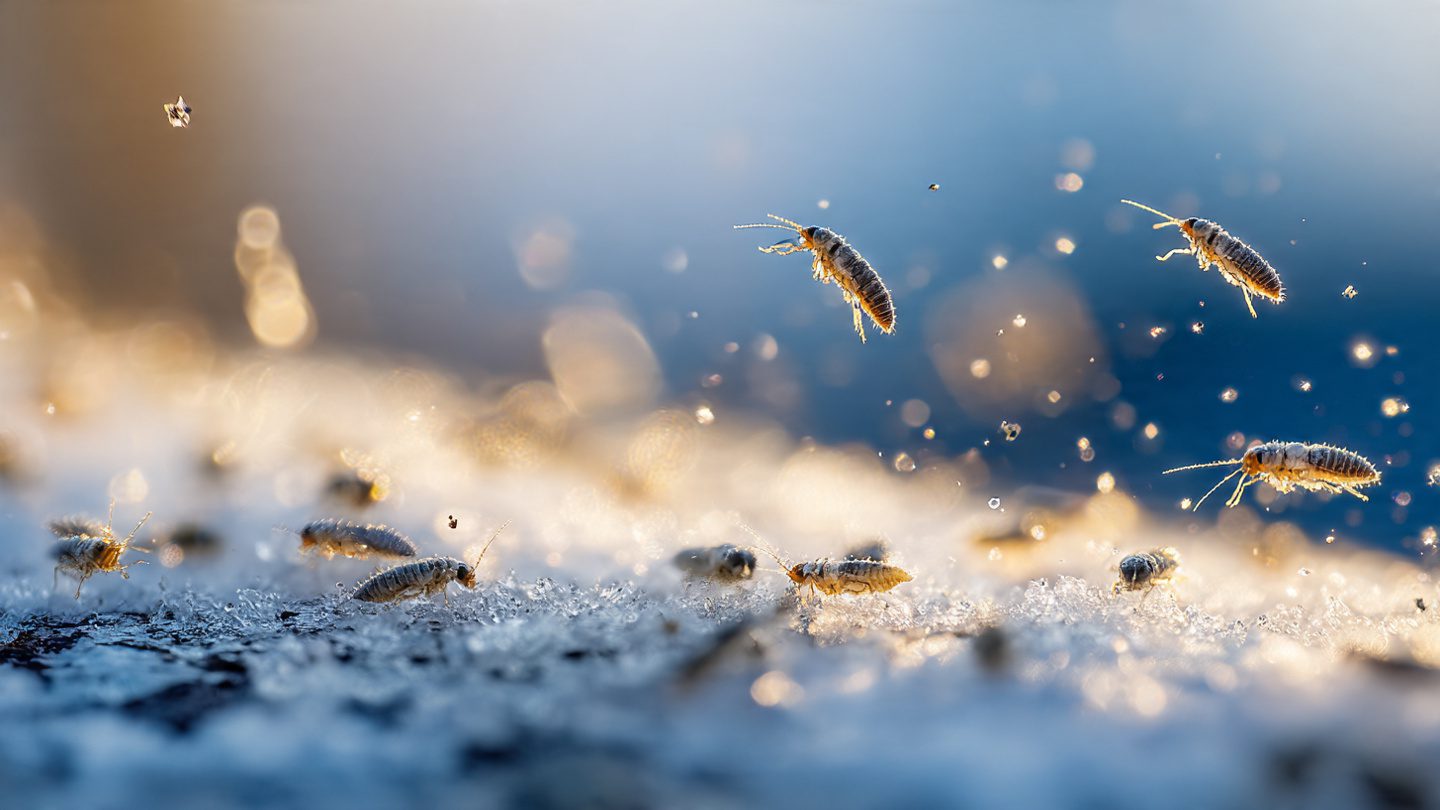
If you’ve noticed specks of dirt jumping across your snow covered yard on warm winter afternoons, you’re witnessing snow bugs one of nature’s most misunderstood creatures.
So, what are snow bugs exactly? Scientifically known as Hypogastrura nivicola, these tiny hexapods belong to the order Collembola (springtails) not true insects, but ancient arthropods more closely related to crustaceans. Despite their “flea” nickname, snow bugs do not bite, feed on blood, or harm pets. Unlike parasitic fleas, these beneficial detritivores spend their lives in soil, emerging onto snow only to harvest pollen and algae.
For homeowners, their presence signals healthy soil biology, while their absence near foundations can indicate moisture issues before they become costly damage. In the sections below, discover seven fascinating facts about these winter survivors from their catapult like jumping mechanism to their natural antifreeze capabilities and learn how to manage them effectively if they wander indoors.
When scientists answer “what are snow bugs,” they point to Hypogastrura nivicola. This species creates those dark patches on late-winter snow. Adults measure barely 1/10th of an inch (1.5–2 millimeters). They display a distinctive purplish-blue-black coloration. This hexapod exploits winter’s most underutilized ecological niche: melting snow surfaces.
Here’s where taxonomy gets fascinating and why your initial assumption that these are “bugs” isn’t quite accurate. While H. nivicola and its close relative Hypogastrura harveyi look like they belong with beetles and ants, they’re actually hexapods in the class Collembola, a lineage that split from true insects (Ectognatha) roughly 400 million years ago, before the Devonian period gave way to forests.
The diagnostic differences are subtle but scientifically significant. Unlike insects, snow bugs possess entognathous mouthparts meaning their mouth structures are folded inside the head capsule rather than external. They’re also wingless (apterygote), lack the ability to breathe through tracheal openings in the same way insects do, and exhibit a unique abdominal structure that true insects simply don’t have.
Most notably, springtails carry the furcula a forked, spring-loaded appendage on the abdomen that we’ll explore in Fact 3. This catapult mechanism isn’t just a quirky feature; it’s a taxonomic hallmark that separates Collembola from all other six-legged arthropods.
So why should homeowners care about ancient mouthpart architecture? Because this specific biology makes H. nivicola a powerhouse detritivore nature’s composting specialist. Unlike predatory insects that hunt live prey, snow bugs consume decaying organic matter, fungi, algae, and pollen. When they emerge onto snow surfaces in February and March, they’re actually “farming” microscopic algae and harvesting windblown pollen that has settled on the snowpack.
In your garden, this translates to accelerated decomposition. A healthy population of springtails in your soil including the winter-active species you see on snow can break down leaf litter up to 40% faster than microbial action alone. They’re essentially microscopic sanitation workers, cycling nutrients back into your topsoil before spring planting begins.
Identification Quick Check: True snow fleas exhibit a characteristic dark blue-black hue. Indoor springtail species tend toward gray, white, or brown instead. On snow, they appear as concentrated “pepper” spots. Check areas where snow has compacted. Also look near maple sap leaks from tubing. This favorite food explains their syrup season association.
Home Connection: The presence of Hypogastrura nivicola on your property indicates healthy, biologically active soil with good organic content. If you’re seeing thousands on your snow, you likely have robust soil microbiology beneath excellent news for your lawn and garden beds come spring.
To the unaided eye, snow bugs don’t look like animals at all. Step outside on a 40°F February afternoon, and you might mistake the dark scattering across your snow for windblown soil, poppy seeds, or cigarette ash until the “specks” begin to leap in chaotic, arc-shaped patterns that no debris could mimic.
The most common search query from perplexed homeowners is some variation of “tiny black bugs on snow look like pepper.” This comparison is remarkably accurate. Individual Hypogastrura nivicola measure approximately 1 to 2 millimeters (about 1/16 to 1/8 inch) roughly the size of a sesame seed or a coarse grain of ground black pepper.
Their coloration amplifies the illusion. Snow bugs exhibit a deep purplish-blue-black exoskeleton that absorbs winter sunlight, making them appear as stark, static dots against white snow. When clustered in colonies of thousands which is typical behavior during mating and feeding frenzies they create irregular dark patches that can stretch several feet across, often concentrated near tree bases, maple syrup equipment, or south-facing slopes where snow warms first.
Visual Identification Checklist:
The Movement Test: The definitive identification method requires no magnification. Gently approach a suspicious dark patch and cast a shadow over it or blow softly across the surface. If the specks explode upward in simultaneous, erratic hops like popcorn kernels hitting hot oil you’ve confirmed springtails. Static debris will simply sit; insects like snow flies (Chionea species) will crawl slowly with distinct leg movements.
Homeowners often confuse snow bugs with other winter-active arthropods. Here’s how to differentiate:
Homeowner Observation Tip: Grab your smartphone. If you take a close-up photo (macro mode) of suspected snow bugs, zoom in to look for the furcula the V-shaped spring appendage tucked under the abdomen. Even in amateur photos, this appears as a tiny “tail” or prong, confirming Collembola versus true insects.
Where to Look on Your Property:
If snow bugs used their legs to leap, they’d be unremarkable. Crickets, grasshoppers, and fleas all jump with powerful hind limbs. But when you ask “how do snow bugs jump,” the answer reveals one of evolution’s most elegant mechanical solutions: these hexapods don’t use their legs at all. Instead, they deploy a biological catapult that predates human engineering by hundreds of millions of years.
Beneath the abdomen of every snow bug lies the furcula a forked, V-shaped appendage derived from modified abdominal legs. At rest, this structure stays folded tight against the belly, held in place by a tiny clasp called the retinaculum. Think of it as a cocked gun, or more accurately, a medieval trebuchet locked and loaded.
When threatened by a shadow, vibration, or breath of wind, the snow bug contracts specific abdominal muscles, releasing the retinaculum. The furcula snaps downward with such explosive force that it strikes the ground or snow surface propelling the hexapod into the air in less than 18 milliseconds. That’s nearly 100 times faster than the blink of a human eye.
Unlike fleas, which jump to board hosts, or grasshoppers, which jump to travel, snow bugs use their furcula purely for evasive escape. They cannot control their trajectory. Each jump is a panic-driven gamble that sends them tumbling through space with no guarantee of a safe landing. This seemingly reckless strategy works because of sheer numbers when thousands jump simultaneously, predators cannot possibly catch them all.
Scaling the Physics: If a human had the equivalent jumping power of Hypogastrura nivicola, they could clear a 30-story building in a single bound. The acceleration forces exceed 400 Gs enough to crush a fighter pilot yet the snow bug’s exoskeleton and minimal mass allow it to survive these launches repeatedly.
The “Dirt That Jumps” Phenomenon: Homeowners often report that snow bugs appear to vanish and reappear magically. This illusion occurs because the furcula’s launch is so rapid that the human eye cannot track the motion. One moment you see a speck; the next, it’s gone, only to land elsewhere seconds later. This unpredictable teleportation-like movement is what earns them the nickname “jumpy dirt.”
Home Relevance: Understanding this mechanism explains why snow bugs behave differently indoors than fleas. If they find their way into your basement (typically during spring thaws seeking moisture), they’ll jump away from you, not toward you. They cannot jump onto beds, furniture, or pets with purposeful direction. The jumping is purely defensive and fundamentally uncontrollable on their part.
Observation Experiment: Place a white sheet of paper on the snow and sprinkle a few snow bugs onto it. Gently tap the paper’s edge. You’ll witness the furcula in action: simultaneous, chaotic eruptions as the entire population launches in random directions. Count the seconds it takes them to reorganize and jump again typically 2–3 seconds to “reload” their catapult mechanism.
This ancient hydraulic-and-spring system, refined over 400 million years, allows these wingless creatures to exploit vertical space without ever evolving flight a perfect adaptation for life in the complex terrain of soil and snow.
While most insects enter diapause a state of suspended animation akin to hibernation during winter months, snow bugs remain biochemically active and mobile even when temperatures plummet. Their secret lies in a molecular innovation that humans have only recently begun to understand: natural cryoprotectants that function identically to the antifreeze in your car radiator.
Inside the body of Hypogastrura nivicola, specialized glands produce antifreeze proteins (AFPs) and high concentrations of glycerol, a sugar alcohol that prevents ice crystal formation. When temperatures drop below freezing, these compounds bind to microscopic ice crystals before they can grow, effectively lowering the insect’s internal freezing point to approximately -8°C (17.6°F).
This biological arsenal explains the counterintuitive timing of snow bug appearances. Unlike boxelder bugs or stink bugs that invade homes seeking warmth in October, snow bugs emerge from the soil specifically during warm winter afternoons (32–45°F / 0–7°C) when solar radiation heats the snow surface just enough to activate their metabolism.
The Maple Syrup Connection: Vermont and Canadian researchers have documented that snow bug activity peaks correlate precisely with the winter holiday season and maple sugaring traditions. As daytime temperatures rise above freezing in late February and March, these hexapods migrate vertically through the snowpack to feed on pollen, algae, and crucially for maple producers dried sap leaked from tubing systems. This predictable emergence makes them an unofficial biological indicator that sugaring season has begun.
Why They Don’t Freeze Solid: At the cellular level, glycerol acts as a “cellular cushion,” preventing the expansion of water molecules that would otherwise shred organelles. Meanwhile, the antifreeze proteins manipulate ice crystal shapes, forcing them into non-damaging configurations rather than the jagged spikes that destroy tissue. This dual protection system allows snow bugs to remain active when other insects would be frozen rigid.
The “Warm Day” Phenomenon Explained: Homeowners often ask why they see thousands of snow bugs after a February thaw but none during a January deep freeze. The answer is metabolic economics. Below 20°F (-6°C), the energy cost of maintaining cryoprotectant levels becomes unsustainable; the bugs retreat deeper into the subnivean zone (the space between soil and snowpack) where temperatures remain stable near freezing. When warm air masses raise surface temperatures, they migrate upward in minutes, creating those sudden “outbreaks” that appear overnight.
Homeowner Implication: If you’re seeing active snow bugs on your property in January or early February, you’re experiencing unusually warm microclimates often indicating south facing exposures, heat leaks from foundations, or dark surfaces absorbing solar radiation. These observations can actually help you identify energy inefficiencies in your home’s winter thermal envelope before they become costly heating bills.
Survival Statistics: Laboratory studies show that H. nivicola can survive temperatures as low as -22°F (-30°C) for short periods, provided they have adequate glycerol reserves. In natural settings, they rarely experience such extremes thanks to snow’s insulating properties another reason why diminishing snowpacks due to climate change pose potential threats to their population cycles.
Unlike “true” winter insects like woolly bear caterpillars that simply freeze solid and thaw in spring, snow bugs maintain active, liquid biochemistry throughout winter. They’re not surviving the cold they’re exploiting it, using the empty ecological niche of snow surfaces to feed while predators remain dormant.
If snow bugs possess antifreeze capabilities allowing winter survival, why risk exposure on the snow surface at all? The answer reveals a remarkably specific dietary strategy: they’re farming microscopic resources that only become available during specific winter conditions, turning your snow-covered yard into a seasonal buffet.
Contrary to parasitic fleas that require blood meals, snow bugs are strict detritivores with a seasonal specialization. During late winter and early spring thaws, several unique food sources become concentrated on snow surfaces:
The Winter Menu:
The Warm Day Trigger: Snow bug metabolism operates on a thermal threshold. When ambient temperatures rise above 32°F (0°C) and solar radiation heats dark snow surfaces to 40–50°F (4–10°C), their enzymatic activity increases tenfold. This isn’t merely comfort it’s a narrow ecological window where liquid water becomes available on snow crystals, allowing them to process these dry food sources.
Vertical Migration Behavior: On warm afternoons, snow bugs execute a coordinated ascent through the snowpack from the subnivean layer (the humid space between soil and snow base) to the surface. They travel through ice channels and air pockets, following thermal gradients upward. By 2:00–3:00 PM on sunny February days, populations peak on the surface; by sunset, they retreat downward to avoid nocturnal freezing.
Maple producers in Vermont and Quebec have long used snow bug swarms as a phenological indicator a biological calendar signaling optimal sugaring conditions. When Hypogastrura nivicola appears in large numbers on snow around sugarbush equipment, it indicates:
This symbiosis is mutualistic: the bugs gain concentrated sugar from leaking tubing, while their presence alerts producers that the season has begun.
Why They Need the Surface: The subnivean zone, while thermally stable, lacks UV radiation which snow algae require to bloom. By emerging onto sun-exposed snow, springtails access primary productivity (algae) unavailable in their soil habitats. They’re essentially commuting from their underground homes to agricultural fields on the snow surface.
Mass Congregation Strategy: Snow bugs exhibit positive thigmotaxis they’re attracted to tight spaces and each other’s bodies. When one bug finds a pollen patch, others follow pheromone trails, creating those dense “pepper” accumulations that alarm homeowners. These aggregations aren’t random; they’re efficient feeding clusters that maximize energy intake during brief warm windows.
Homeowner Relevance: If you observe sudden snow bug “outbreaks” on your property, you’re witnessing a microclimate event. Areas with:
will attract disproportionate numbers. This isn’t an infestation; it’s an indication of rich biodiversity in your soil and productive winter ecosystems.
The Timing Precision: Individual snow bugs may only survive 3–5 active days on the surface before retreating to soil to lay eggs. Their emergence is a calculated gamble: risk freezing for high-energy food, or starve slowly in the subnivean zone. Warm winter afternoons represent the only safe opportunity to stockpile nutrients for spring reproduction.
The transition from winter to spring triggers a predictable anxiety: as snowpacks recede, homeowners wonder if the thousands of snow bugs they’ve observed dancing on their lawns will soon be dancing across their kitchen floors. The reality is more nuanced and less alarming than a full-scale invasion, but it does reveal important truths about your home’s moisture management.
First, the critical distinction: snow bugs (Hypogastrura nivicola) rarely enter homes directly from snow. The individuals you see on winter snowpacks are adapted to cold, UV exposure, and outdoor food sources. When snow melts, these specific populations retreat into soil to lay eggs and complete their life cycle, not to invade your basement.
However, indoor springtails often different species like Sinella curviseta or Entomobrya signal an entirely separate issue that melting snow can exacerbate: excess moisture.
According to the Illinois Department of Public Health, springtails are classified as occasional invaders that enter structures seeking water when soil becomes saturated. They breathe through a thin, permeable cuticle that requires constant moisture to function.
When outdoor conditions become too dry (frozen soil with no liquid water) or when heavy snowmelt creates saturated soil that pushes populations upward, they explore foundation cracks and window sills seeking humidity.
Springtails require relative humidity above 50% to survive more than 48 hours indoors. If your basement or bathroom maintains lower humidity, any wanderers will desiccate and die naturally.
This makes them excellent if unintended moisture indicators. Seeing active springtails indoors means you have humidity levels high enough to potentially support mold growth.
When to Actually Worry: Unlike termites or carpenter ants, springtails cause zero structural damage. They don’t eat wood, fabric, or food stores. However, persistent indoor populations indicate:
Control Without Chemicals: If you find concentrations in specific areas:
The Snow Bug vs. Indoor Springtail Connection: While the dark snow fleas on your yard won’t invade en masse, their presence indicates healthy soil biology that could, under the wrong moisture conditions, support indoor species. Think of outdoor snow bugs as the “canary in the coal mine” for soil health, and indoor springtails as the “smoke alarm” for excess humidity.
Seasonal Timing: Most indoor springtail complaints occur not in deep winter, but during March and April when snow melts rapidly and basements experience hydrostatic pressure. If you observed heavy snow bug populations on your property in February, inspect your basement moisture barriers before the thaw to prevent unrelated indoor species from becoming noticeable.
Professional Help: Call a pest control specialist only if you’ve addressed moisture issues and still see hundreds daily this may indicate a hidden plumbing leak or structural water intrusion requiring remediation, not extermination.
After exploring their jumping mechanics and winter survival, we return to the fundamental truth: snow bugs are beneficial decomposers that signal healthy soil ecosystems.
While earthworms get all the credit, springtails like Hypogastrura nivicola are equally critical especially in winter when worms burrow deep. These hexapods perform three essential services:
Unlike most decomposers that shut down in cold months, snow bugs remain active in the subnivean zone, processing autumn leaves while everything else sleeps. This gives your garden a head start on the growing season they’ve already prepped soil nutrients weeks before spring thaw.
Visual Proof of Soil Health: During maple syrup season, producers use snow bug activity as a phenological indicator of high organic content and robust fungal networks. For homeowners, those pepper-specks on snow mean:
If you practice no-till gardening, snow bugs are essential partners. They perform natural tilling breaking up soil, mixing organic matter, and creating pore spaces without disturbing fungal networks. As snow melts, they retreat into topsoil, delivering mineralized nutrients exactly when daffodils and early vegetables need them most.
Unlike ticks, mosquitoes, or Japanese beetles true pests that damage health and gardens snow bugs are ecosystem services personified. They don’t want your blood, your woodwork, or your pantry goods. They want your leaf litter, your fungal networks, and your snow algae. When you see them jumping on your lawn, you’re witnessing a 400-million-year-old ecological process that makes modern gardening possible.
Protect them by avoiding broad spectrum insecticides on snow and maintaining organic matter in your soil. A yard with snow bugs is a yard with biodiversity and that’s the foundation of every thriving home landscape.